Selected design work
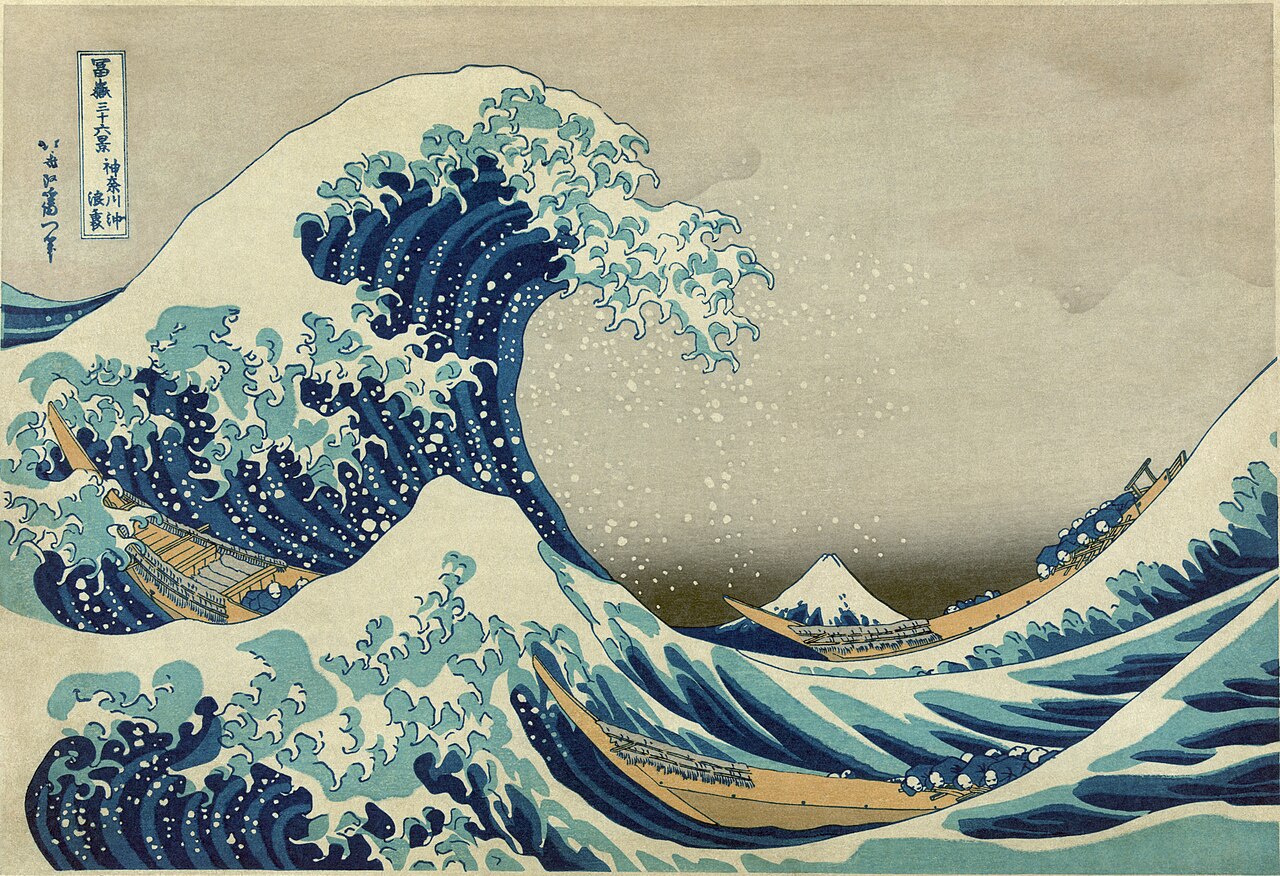
Title: The Great Wave off Kanagawa
Designer: After Katsushika Hokusai
Date: 1830–1833
Medium: Polychrome woodblock print (ukiyo‑e)
Original size: 25.7 × 37.9 cm
Source: Wikimedia Commons
The print shows a huge wave towering over several long rowing boats, while the snow‑capped Mount Fuji appears small in the background. The wave curls from left to right and its foam resembles claws. This dynamic moment makes viewers wonder what will happen next.
Visual analysis
The composition is dominated by the sweeping wave that rises from the left and fills much of the sky. Its white foam looks like clouds and creates tension as if it is about to engulf the boatmen below. Smaller waves in the foreground repeat the same curving motion, guiding our eyes from left to right and back again. Nestled beyond the chaotic water is Mount Fuji; the tiny mountain anchors the scene and provides a sense of calm despite the danger. The perspective combines a slightly elevated viewpoint with a horizontal one, making us feel as if we are both observing from above and standing in a boat. This unusual perspective increases depth and emphasises the scale difference between the huge wave and the distant mountain.
Colour plays a central role in the print. Hokusai used varying shades of blue and a synthetic pigment called Prussian blue, which was imported from Europe and prized for its durability. The limited palette of deep blue, off‑white and muted beige creates harmony and unity; all elements feel connected. Within this harmony, contrast emerges through the stark difference in size and value: the giant dark blue wave and boats stand out against the lighter sky and Mount Fuji. Contrast also appears in texture: the rough, churning water contrasts with the smooth area of the mountain and sky, highlighting the conflict between nature and calmness.
Several design principles can be observed. The wave creates emphasis by dominating the composition and drawing immediate attention. Movement is achieved through the curving lines of the waves that lead the viewer’s eye across the scene towards Mount Fuji. Repetition in the smaller waves and foam unifies the design and reinforces rhythm. Balance is asymmetrical: although the wave occupies much of the left side, the visual weight of the mountain and the vertical text on the right side stabilise the composition. The Gestalt principle of figure–ground is evident in the way the wave (figure) stands out against the flat sky (ground), yet the foam visually blends into clouds. The limited colour scheme and consistent woodblock style foster harmony and unity.
Overall, the work captures a moment of suspense between nature’s power and human fragility. The careful composition, use of colour and masterful control of movement make this print an enduring inspiration.
Idea sketches and rationale
Idea 1: "Wave of Waste"

This doodle imagines the famous wave as a mass of discarded plastic bottles. The irregular bottle shapes show the chaotic nature of pollution. Small boats at the bottom highlight human vulnerability. The sketch uses repeated curves and overlapping forms to hint at movement and rhythm.
Idea 2: "Journey on the Wave"

Here, a bullet train glides along a stylised wave, with Mount Fuji in the background. The scribbled lines suggest speed and energy. The composition echoes Hokusai’s print by placing the wave in the foreground and the mountain behind. This idea blends traditional imagery with modern transportation.
Idea 3: Wave‑pattern packaging

This sketch shows a reusable water bottle decorated with a repeating wave motif. The simple line pattern wraps around the bottle, creating unity and harmony. Rough lines and uneven spacing give the drawing a handmade feel, suggesting the packaging could remind users of the ocean while promoting sustainability.
References
- Alicia du Plessis. “The Great Wave Off Kanagawa – An Analysis.” Art in Context, 2022.
- Jessie Chang. “CONTRAST: The Principle of Design.” Winged Canvas Blog, 2021.
- Jessie Chang. “UNITY & HARMONY: The Principles of Design.” Winged Canvas Blog, 2021.
- Katsushika Hokusai. “The Great Wave off Kanagawa.” ca. 1830–1833. Polychrome woodblock print. Wikimedia Commons.


评论
发表评论